Why Americans’ View of Israel Has Hit a Record Low
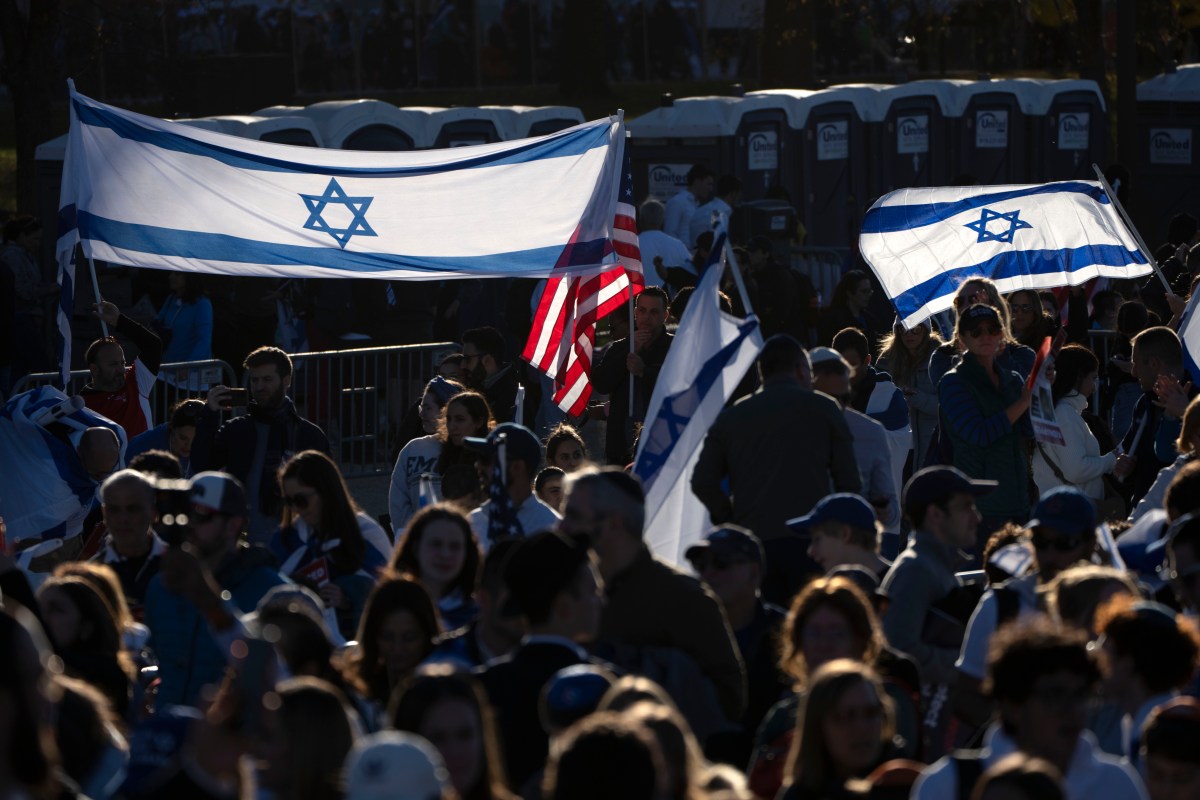
Americans’ view of Israel is at its lowest point in almost 50 years, a new poll shows, as the NAZA documentary, which accuses Israel of recklessly killing civilians in Gaza, hits American cinemas.On a favorability thermometer scale, where zero represents a cold, unfavorable view and 100 is the warmest reading possible, Americans gave Israel a rating of 44, according to new research by the Chicago Council on Global Affairs published on Monday. This is the lowest level ever recorded by the nonpartisan organization, which has surveyed Americans’ foreign-policy views since 1974.Favorability for Israel has declined across the political aisle, among Democrats, Republicans and independents, the poll found, with more than half of Americans in favor of the U.S. decreasing or stopping military aid to the country.It comes as NAZA, named after the Hebrew acronym for collateral damage, is set to open at theatres in Austin, Chicago, Los Angeles and Seattle on October 9, after much controversy over the allegations in the film, which Israel vehemently denies. It has already started showing in New York.The film, produced by The Guardian, does not have a traditional distributor and is playing in the U.S. and abroad with the help of independent film studio mk2.Its contents, which the producer says “reveal the systems behind Israel’s calculated mass killing of Palestinian civilians in Gaza” based on anonymous interviews with 24 members of Israeli intelligence and the military, have prompted intense backlash from Israel and advocacy groups in America.A view of protestors during the "NAZA" screening at the Sag Harbor Cinema during the 2026 Hamptons International Film Festival on October 3, 2026, in ... | (Photo by Sonia Moskowitz/Getty Images)The Israel Defense Forces (IDF) issued a lengthy statement at the beginning of this month, saying it “categorically rejects these allegations,” questioning the film’s sources and arguing it contains “absurd contradictions.”Newsweek contacted the Israeli Embassy in Washington and NAZA filmmakers Yuval Abraham and Rachel Szor via email for comment.America’s Record-Low View of Israel in NumbersThe Chicago Council’s new overall score of 44, the lowest in the organization’s history, follows a consistent decline in favorable views toward Israel since 2022, when it was 58.This shift can be seen across all political groups, but most sharply among Democrats, who dropped from an average of 52 in 2022 to 30 this year. Republicans’ view decreased from 69 to 62 and independents' from 56 to 41.The current 32-point difference between Republicans and Democrats on favorability toward Israel is now at its highest point ever.But there are differences among factions in the same political camps, with MAGA Republicans still showing a favorable view of Israel – 67 compared to non-MAGA Republicans who average at 55.Likewise, Democrats who identify as liberal give a lower score for Israel (27) than those who describe themselves as moderate (34).For the first time ever, more than 50 percent of Americans believe Washington, D.C., should reduce or cut US military assistance to Israel – 56 percent up from 38 percent in 2022.The Chicago Council surveyed 2,156 adults between July 10 and 21 this year. It reports a margin of error of +/-2.2 percentage points.What is Driving the Shift?The report’s authors, Dina Smeltz, the council’s managing director and chair of public opinion and foreign policy and research associate Lama El Baz, point to “Israel’s war against Hamas… the United States government’s support for it, as well as the joint US-Israeli war on Iran” for “dramatically reshap[ing] the American public’s perception of one of Washington’s strongest partners in the Middle East.”“The previously bipartisan public consensus on a strong relationship with Israel is now marked by deep divisions along partisan lines,” they conclude. “Ongoing debates around continued U.S. support for Israel could help to shape the outcome of the upcoming midterm elections for some voters and, over time, future US policy toward this longstanding US partner.”Israel and advocates have long blamed misleading information for negative views of the country. The Anti-Defamation League (ADL), a U.S. nonprofit that combats antisemitism, warns about incomplete information in reports about Israel, a “pattern of scapegoating Jewish people,” stereotypes and oversimplification of the conflict in the Middle East.The IDF invokes this stance in its response to the NAZA film, arguing that the information in the documentary cannot be verified and lacks context.Unrelated file photo of supporters holding Israeli and American flags as they gather on the National Mall at the March for Israel on Tuesday, Nov. 14,... | AP Photo/Mark SchiefelbeinWhat To Know About NAZANAZA first premiered on September 10 at the 83rd Venice International Film Festival, where it won the festival’s Special Jury Prize. It then premiered at the New York Film Festival on September 26 at Lincoln Center’s Alice Tully Hall.The documentary is built on investigations that were published by Israeli-Palestinian outlet +972 Magazine, Hebrew-language publication Local Call and The Guardian between 2023 and 2025.Filmmakers Abraham and Szor say the film includes testimonies from officers and soldiers who “conducted the surveillance, who calculated how many innocent people were likely to be killed in each house, and who repeatedly gave the green light to bomb entire families.”They wrote for +972 Magazine: “The conclusion that we draw from the testimonies is clear: The mass killing of Palestinian civilians in Gaza was not a ‘tragic byproduct’ of a war against Hamas, as it is commonly portrayed in Israel, but a premeditated, calculated, and intentional act.”Rachel Szor and Yuval Abraham pose with the Special Jury Prize Award for "Naza" at the Winners Photocall during the 83rd Venice International Film Fes... | (Photo by Elisabetta A. Villa/Getty Images)The allegations include claims that the Israeli military used artificial intelligence tools that could predict the number of civilian deaths and carried out those operations anyway.The IDF addressed this accusation directly, saying: “Decisions regarding the selection and approval of strikes in the IDF are made by human personnel only, in accordance with IDF guidelines, and not by artificial intelligence.”IDF Speaks Out Against NAZAThe IDF said the film “relies on anonymous testimonies from individuals whose identity cannot be verified, including whether they served in the IDF, in what capacity, or whether they were involved in the matters about which the allegations are being made.”It went on to argue that the claims attributed to soldiers cannot be true because they “are regarding national and military strategy that are clearly beyond the knowledge of junior-level soldiers.”“The IDF strikes military targets and makes unprecedented efforts to minimize harm to civilians,” it said. “Hamas continues to systematically operate from within the civilian environment, embedding its operatives and military infrastructure among the population and exploiting civilian areas for terrorist purposes.”The IDF's full statement reads: "The IDF categorically rejects these allegations."According to the publications, the film relies on anonymous testimonies from individuals whose identity cannot be verified, including whether they served in the IDF, in what capacity, or whether they were involved in the matters about which the allegations are being made."The excerpts cited include claims regarding national and military strategy that are clearly beyond the knowledge of junior-level soldiers. There are references to situations in which IDF Intelligence Directorate soldiers, who were allegedly interviewed for the film, by definition would not have been involved. There is also an incorrect use of legal terminology by individuals who are not legal professionals, as well as internal and absurd contradictions, such as the claim that unintended harm resulting from lawful attacks was carried out deliberately or constituted part of “genocide,” without understanding the meaning of these terms."The IDF operates in the Gaza Strip in order to protect Israeli civilians and directs its military activity against terrorist organizations, foremost among them Hamas, in accordance with international law and the laws of armed conflict. As part of this, the IDF strikes military targets and makes unprecedented efforts to minimize harm to civilians. Hamas continues to systematically operate from within the civilian environment, embedding its operatives and military infrastructure among the population and exploiting civilian areas for terrorist purposes. When specific suspicions of violations of the law by an IDF soldier arise, the IDF is fully committed to investigating them and bringing those responsible to justice through independent enforcement mechanisms. A soldier who witnesses a violation of the law is required under military orders to report it so that the need to open an investigation can be examined. This also applies to individuals who were interviewed for the film."Regarding the allegations concerning the use of artificial intelligence - decisions regarding the selection and approval of strikes in the IDF are made by human personnel only, in accordance with IDF guidelines, and not by artificial intelligence."The Israeli-American Council is one of several American advocacy groups that have also spoken out about the film, planning demonstrations outside screenings of the movie.In a call to mobilize outside California’s Smith Rafael Film Center on Tuesday, it says supporters should gather to “challenge the film’s narrative and ensure the truth of October 7 is not forgotten.”Newsweek’s reporters and editors used Martyn, our AI assistant, to produce this story. Learn more about Martyn here. Contact Newsweek editors on this story: John Fitzpatrick and Gray R. ThomasIndependent Journalism NeedsYou!Become a member for a fresh perspective—ad-free reading, access to our editors, and insight beyond the conventional wisdom.