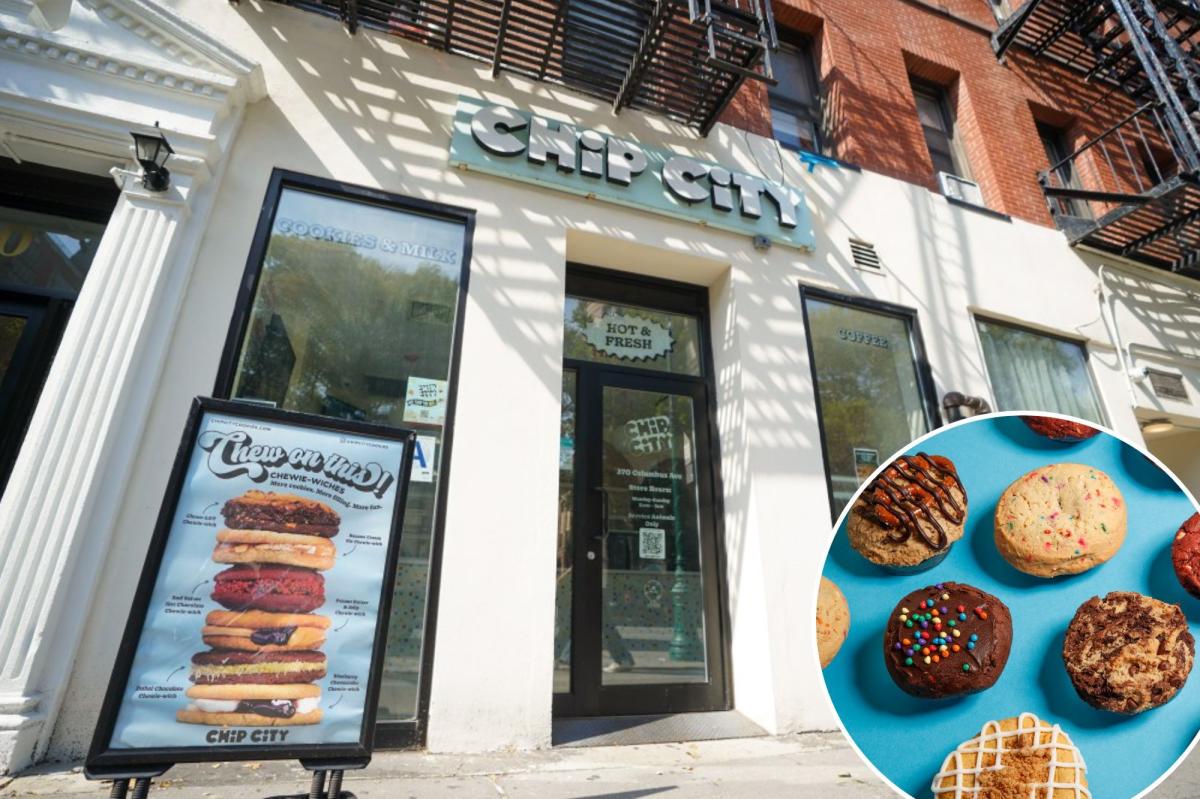
Chip City Sparks Uproar After Abruptly Closing All Its Stores
Apparently, that’s how the cookie crumbles.
Chip City, the viral New York bakery chain that ballooned from a Queens storefront into a multi-state cookie empire backed by millions from Danny Meyer’s investment firm, appears to have abruptly shuttered stores across New York City and other major markets — just days after its co-founder sued the company and its controlling investor.
“Despite extensive efforts to stabilize our business in the face of significant macro-economic headwinds, we have made the very difficult decision to close all of our Chip City locations,” the company told The Post in a statement Friday.
“We are grateful to our dedicated employees and loyal customers who have supported us for the past 10 years.”
Chip City had not publicly announced a systemwide shutdown as of Friday morning, but according to a former employee, an email purportedly sent to employees Thursday evening said Chip City would “cease all store operations,” permanently closing its 22 remaining stores at the end of the day.
“Our industry and business have faced a challenging environment,” the email said, citing weaker consumer spending and changing preferences. “Unfortunately, we no longer have the funding required to operate this business.”
“This was easily the most stressful and unprofessional company I’ve ever worked for,” the former employee wrote online and shared the company-wide email that was sent.
The email told workers it would be their final day and said they would be paid through Oct. 18 under Fair Workweek policies.
The sudden shutdown was already playing out across social media Thursday, where customers posted videos of darkened storefronts and traded information about which shops had closed.
Hearing rumblings that every Chip City location has suddenly and permanently closed, including Astoria and Sunnyside. Pretty surprising.
“All locations shut down with no notice,” one customer told neighbors on the Upper East Side, saying staff received an email that it would be their final day.
Adding to the mystery, NYPD Evidence Collection Team officers were seen photographing the shuttered Upper West Side location Thursday, according to a local reporter who posted images from the scene.
When approached, one man at the site reportedly told him, “please, please don’t talk to the media.”
The reporter said NYPD officers referred him to the department’s public information office, which told him it had no information tied to the address as of Thursday morning.
It was not immediately clear why the Evidence Collection Team was at the store or whether its presence was connected to the closure.
The apparent New York closures follow a rapid string of shutdowns elsewhere.
Chip City recently closed all three of its Connecticut locations while stores in Virginia have also shuttered. By late September, the company’s website listed just 24 locations in New York, New Jersey and Texas, a sharp contraction from its footprint at the height of its expansion.
Something very odd is going on in connection with today's permanent closure of the UWS Chip City.
Multiple NYPD Evidence Collection Team officers are on site and taking photos of the storefront.
A man on a bike filling out some sort of document said, "please, please don't talk… https://t.co/MFqUNmubiP pic.twitter.com/mCcivSSCtu
Chip City rode the same oversized-cookie wave that turned brands like Crumbl and Last Crumb into social-media sensations, helping push cookies into the kind of viral-dessert moment cupcakes once had with brands like Magnolia Bakery. The category exploded around rotating flavors, limited drops and massive, camera-ready cookies built for TikTok and Instagram
Founded in Astoria in 2017, Chip City built a cult following around their nearly six-ounce cookies with crisp edges, molten centers and a rotating weekly menu.
Its rapid growth attracted $17.5 million from Danny Meyer’s Enlightened Hospitality Investments in two rounds — $10 million in 2022, followed by another $7.5 million in 2024 to fuel further brick-and-mortar expansion.
But as stores began disappearing this fall, internal turmoil was baking.
Just days before the latest closures, Chip City co-founder and former CEO Peter Phillips filed a lawsuit in New York Supreme Court against the company, Enlightened Hospitality Investments and executives Nicolas Baizan and Fred LeFranc, alleging a bitter dispute over his compensation, benefits, company web domains and hundreds of thousands of dollars in small-business loans.
Phillips claims he stepped down as CEO in March as part of a restructuring that left Enlightened Hospitality Investments as Chip City’s controlling investor. He remained in an agreed paid transitional role through December, with $157,500 in salary and family health benefits promised under the deal.
“Although our client has not been part of ownership for some time, he is shocked at what happened to a company that he and his friend had put together,” Phillips’ attorney, Israel Klein, Pardalis & Nohavicka, told The Post.
The September 28 lawsuit alleges the relationship between the parties became tumultuous over the summer, when Phillip claims Chip City froze his pay while pressuring him to hand over company-related web domains and sign paperwork tied to more than $640,000 in SBA loans he says he still personally guaranteed.
After he demanded payment, Phillips says the company terminated him and moved to cut off his health coverage.
The lawsuit accuses Chip City and the other defendants of breach of contract, unlawful wage withholding, retaliation, and other violations. Phillips is seeking unpaid compensation, damages, and other relief.
The defendants have not yet responded to the allegations in court, and the lawsuit does not establish that the dispute caused the recent store closures.
Still, the timing adds another layer of uncertainty around a company that, until recently, was touting aggressive growth.
Even as customers posted videos of closed locations, Chip City’s social media continued promoting its weekly lineup of cookies to more than 300,000 Instagram followers. It is unclear how operations will continue to persist at this time.
With the closure come hundreds of employees now out of work.