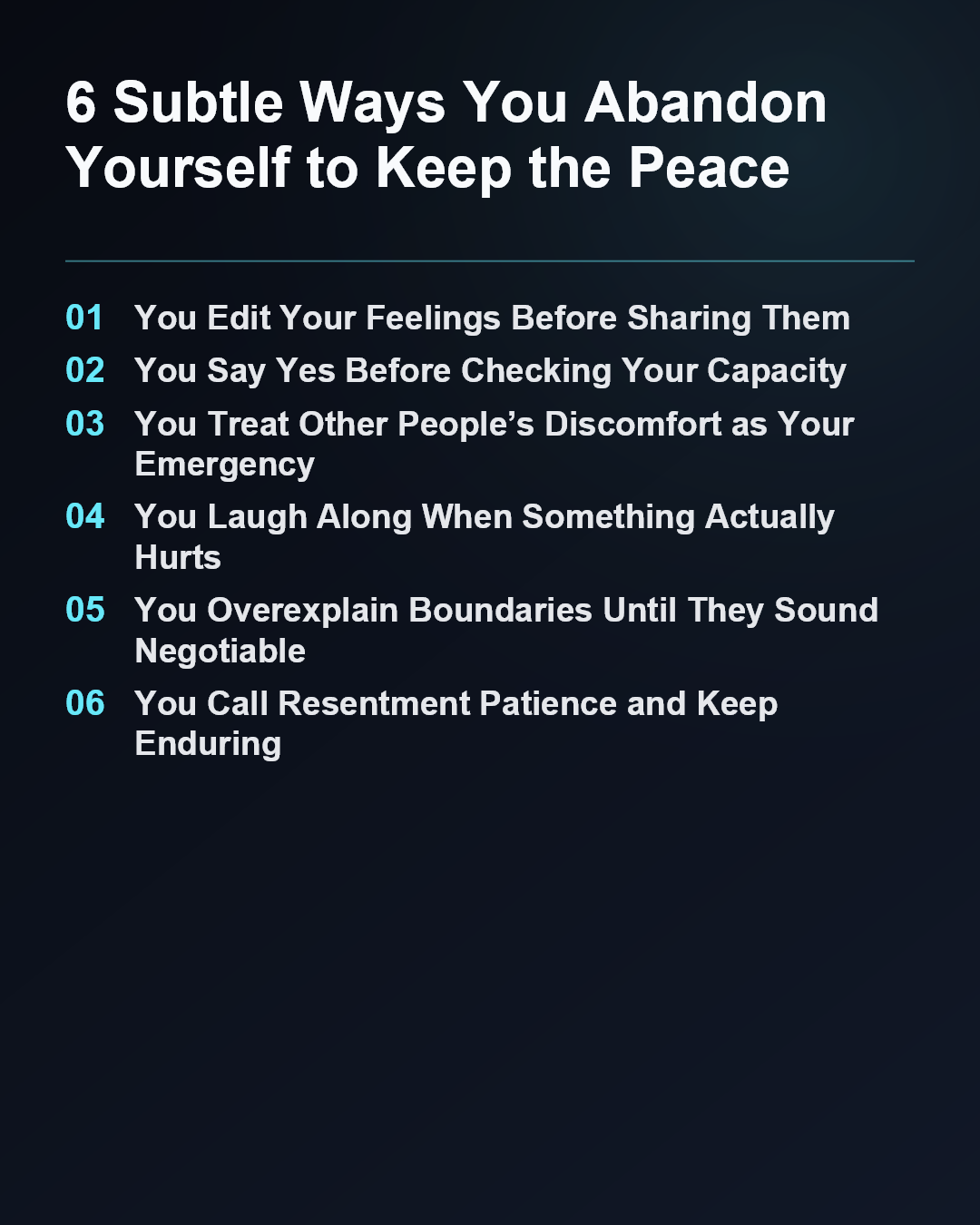
6 Subtle Ways You Abandon Yourself to Keep the Peace
Before speaking, you quietly remove anything that might disappoint, challenge or inconvenience someone else. “That hurt me” becomes “It’s probably not a big deal.” This may prevent immediate tension, but it also keeps others from knowing the real you.
Try expressing one honest feeling without minimizing it or apologizing for having it. Clear, measured honesty gives a relationship the chance to handle reality instead of relying on your silence.
An automatic yes can be less about generosity and more about avoiding the discomfort of saying no. You agree to help, attend or take on extra work, then feel resentful when your own needs are pushed aside.
Before answering, create a pause: “Let me check and get back to you.” That small delay helps you consider your time, energy and genuine willingness before making a commitment you may regret.
Someone becomes quiet, irritated or disappointed, and you immediately start repairing the mood. You explain yourself repeatedly, soften a reasonable boundary or accept blame just to restore calm. But another person’s discomfort does not automatically mean you have done something wrong.
Ask yourself, “Is there something I need to repair, or am I simply witnessing a feeling?” You can remain caring without taking responsibility for every emotional reaction around you.
Humor can disguise moments that deserve a response. A friend makes a cutting remark, everyone laughs, and you join in because objecting might make the room uncomfortable. Later, the comment stays with you.
You do not need a dramatic confrontation. A simple “I know you’re joking, but that didn’t land well with me” is enough. Naming the impact teaches people where your limits are and reminds you that belonging should not require self-betrayal.
When you believe a boundary must be approved, you may surround it with long explanations, apologies and exceptions. “I can’t come tonight” turns into a detailed defense that invites the other person to challenge every reason.
A boundary is clearer when it is brief and respectful: “I’m not available tonight, but thank you for inviting me.” You can offer context when you genuinely want to, but your limits do not become valid only after someone agrees with them.
Resentment often builds when you repeatedly tolerate what you are unwilling to address. You may call it being easygoing, loyal or patient, while privately keeping score. Eventually, a small incident triggers a reaction that seems larger than the moment.
Treat recurring resentment as information rather than proof that you are unkind. Identify the unmet need beneath it, then make a request, change your participation or step back. Peace created by endurance alone rarely feels peaceful inside.